Don’t Lose the Muscle You'll Desperately Need in Your 60s and 70s.
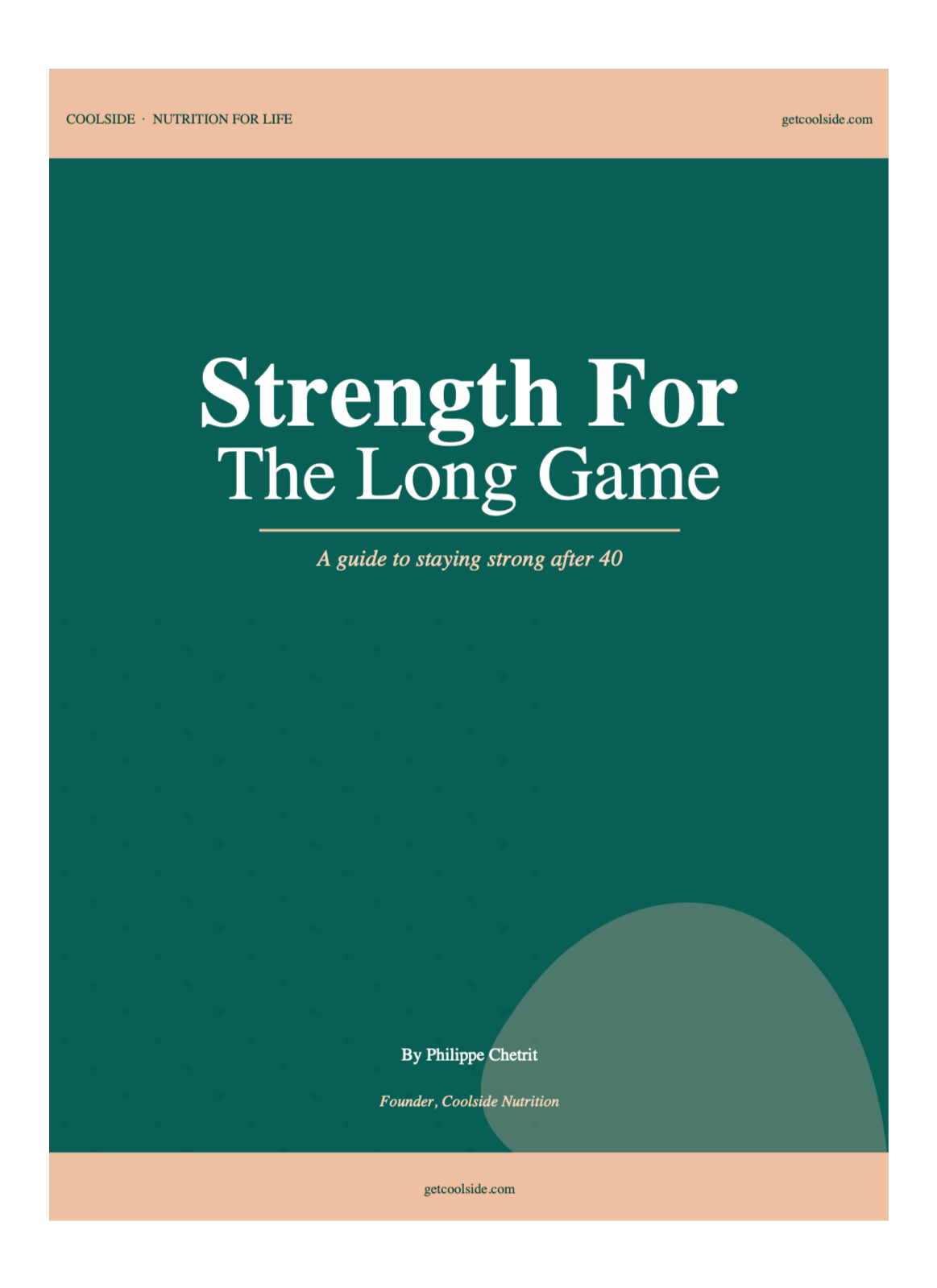
Strength For The Long Game is a free guide that shows you exactly what's changing in your body after 40 — and the five simple levers that can change the trajectory before it's too late.
You noticed it. You just haven't named it yet.
It wasn't a dramatic moment. There wasn't a single morning you woke up and felt old.
It was subtler than that.
A workout that used to feel routine felt oddly heavy. You needed an extra day to recover from something that wouldn't have touched you three years ago. A weekend that involved more walking than usual left your knees complaining on Monday.
You put it down to stress. A bad week. Not enough sleep.
But it happened again the week after that. And the one after that.
Maybe you've noticed your body composition shifting — not because you're eating differently, but because something has quietly changed in the way your body works. You feel strong some days and oddly fragile on others. Small tweaks linger. Big efforts take longer to bounce back from.
You're not imagining it.
And it's not just getting older. It's a specific biological process — one that's well understood, well documented, and almost entirely unaddressed by mainstream health advice.
You're already in it. The only question is whether you address it now, or wait until you have no choice.
What's actually happening inside your body right now
Beginning in your late 30s and accelerating through your 40s and 50s, your body begins losing muscle mass at a rate of 3–8% per decade. The medical term is sarcopenia. The practical translation is this:
Every year you do nothing, you lose a little more of the physical capability that makes life feel easy.
This isn't about vanity. Muscle isn't just something you see in the mirror. It's the tissue that:
Regulates your metabolism and controls blood sugar
Stabilizes your joints and protects your spine
Keeps you upright when you slip on ice
Determines whether carrying your suitcase feels easy or dangerous at 72
At the same time — and this is the part most people don't know — your muscles become increasingly resistant to the training and nutrition signals that used to work automatically. Researchers call it anabolic resistance. What it means in practice: the protein you ate at dinner, the gym session you did on Wednesday — they're producing less of a muscle-building response than they did five years ago.
It's not that what you're doing is wrong. It's that the rules have changed. And nobody handed you the new rulebook.
Add the hormonal shifts. The slower tendon recovery. The changes to sleep architecture that reduce the body's ability to repair overnight. All of it happening quietly, simultaneously, beneath the surface.
The result is a compounding problem that most people only notice when it becomes a crisis — a serious injury, a health scare, a moment when they realise they can no longer do something they used to take for granted.
The research is unambiguous on one thing: the earlier you address this, the easier it is to slow down. The longer you wait, the steeper the climb.
Thousands of people over 40 are already reading this. Your copy is waiting.
What the next 20 years look like if you don't change anything
We're not going to dress this up.
The research on untreated sarcopenia and age-related muscle loss is not comfortable reading. Here is what the clinical literature consistently shows for adults who don't take deliberate action in their 40s and 50s:
Falls become the leading cause of injury. Muscle weakness is the single strongest predictor of fall risk in older adults. Falls are the leading cause of injury-related death in people over 65. This is not a fringe statistic — it is the central finding of decades of gerontology research.
Functional independence narrows. Getting up from the floor. Climbing a flight of stairs without holding the rail. Carrying bags in from the car. These things become effortful. Then difficult. Then something you quietly stop doing. Then something you need help with.
Metabolic health deteriorates. As muscle tissue declines, insulin sensitivity drops. The risk of type 2 diabetes climbs — not because of diet, but because the body's primary site of glucose disposal has shrunk. Body composition shifts. Energy drops. The cycle becomes self-reinforcing.
Cognitive resilience declines. Emerging research links sustained muscle mass with improved cognitive function in later life. The connection between physical capability and mental sharpness is more direct than most people realise.
Chronic pain becomes the background noise of daily life. Without the muscular scaffolding that holds joints in alignment, wear accelerates. Knees. Hips. Lower back. The people who say they "just have a bad back" often have a muscle loss problem that nobody identified twenty years earlier.
This is not meant to frighten you for the sake of it.
It is meant to make one thing absolutely clear: the cost of inaction is not neutral. There is no holding pattern here. Every month that passes without deliberate action is a month of compounding loss.
The good news — and there genuinely is good news — is that you are reading this now. Which means you still have significant time on your side.
What happens when people take this seriously
"I read this guide expecting another generic protein shake pitch. What I got was the clearest explanation I've ever seen of why my body stopped responding the way it used to — and a plan that actually made sense for my life. I'm 54. I wish I'd had this at 42." — David M., 54, former runner
"The protein timing section alone changed my approach completely. I was eating about 8 grams at breakfast and wondering why nothing was working. Three months in, my physio noticed a visible difference in my muscle tone without me changing my training at all." — Sarah K., 47, mother of three
"I've been active my whole life. I thought I was doing everything right. This guide showed me three specific things I was getting wrong — all of them subtle, none of them obvious. I genuinely can't recommend it enough." — James R., 51, works in finance
"My doctor told me I was losing bone density faster than expected. I started taking this stuff seriously about 18 months ago. At my last scan, that trend had reversed. I'm not saying it was only this — but the framework in this guide is a big part of what I changed." — Caroline T., 58
Here's exactly what you get — free, today.
Strength For The Long Game is a comprehensive guide written for people who don't want to become gym obsessives. They just want to stay capable, strong, and independent for decades to come.
The kind of framework inside this guide would cost you $200+ per hour with a sports nutritionist. It's yours free because the best thing we can do for our customers is make sure they actually understand the problem before they buy anything.
Here's what's inside:
✦ The Science, Made Human A clear-eyed walkthrough of exactly what's changing in your body after 40. Sarcopenia. Anabolic resistance. Hormonal shifts. Tendon health. Sleep architecture. All of it explained without alarm or jargon — so you understand why the strategies work, not just what to do.
✦ The Five Levers The five areas within your control that have the greatest impact on strength and muscle preservation after 40. Most people are working hard on the wrong things. This section reorients your effort toward what actually moves the needle.
✦ Protein Timing — The Single Most Important Shift It's not about eating more protein. It's about when you eat it, and how much at each sitting. Most adults are accidentally eating 90% of their daily protein at dinner — and missing two critical muscle synthesis windows every single day. This section shows you exactly what to change, with a practical meal framework.
✦ Eight Smoothie Recipes Built For Your Life Not "performance shakes." Not gym culture in a glass. Eight genuinely delicious recipes built around Coolside's seed protein blend, each designed to make hitting 30–40g of protein at breakfast feel effortless rather than clinical
✦ The Myth-Busting Section The five most confidently stated pieces of advice circulating in the wellness world right now that are actively working against you after 40. Including why extreme fasting may be accelerating the exact muscle loss you're trying to prevent.
✦ The Data Visualizations Two clear charts showing exactly how muscle mass and hormone levels change across the decades — with and without intervention. The visual difference is stark. And motivating.
-
Fair. Most of them are. This one ends with smoothie recipes and a mild suggestion that Coolside makes a protein product you might like. The guide itself is 30+ pages of actual science and practical frameworks. If you never buy anything from us, that's fine. You'll still have the guide.
-
Almost certainly yes — and this is exactly the group that benefits most. Sedentary people know they have a problem. Active people over 40 are often working hard in the wrong direction, missing the specific nutritional and training signals their body needs at this stage. The guide was written for people like you.
-
You don't have to. The framework in this guide requires 2–4 strength sessions per week and a shift in how you distribute your protein across the day. That's it. No extreme protocols. No six-day training weeks. No elimination diets.
-
The guide was written for anyone over 40. The sections on hormonal shifts specifically address the menopausal transition and what it means for muscle retention. The protein timing framework, the training principles, and the recovery strategies apply equally regardless of gender.
-
We send you the guide. After that, you'll occasionally hear from us when we have something genuinely worth sharing — new research, a recipe, a product update. We don't sell your data. We don't send daily emails. You can unsubscribe with one click at any time.
You're already in the window where this matters most.
Most people don't start thinking about muscle health until they're forced to. A fall. A diagnosis. A moment when they realise they can't do something they used to take for granted.
This guide is free. It takes 30 minutes to read. And it will change how you think about the next 40 years of your physical life.